Startup story #10 - Flycatcher
USI Startup Centre
18 November 2024
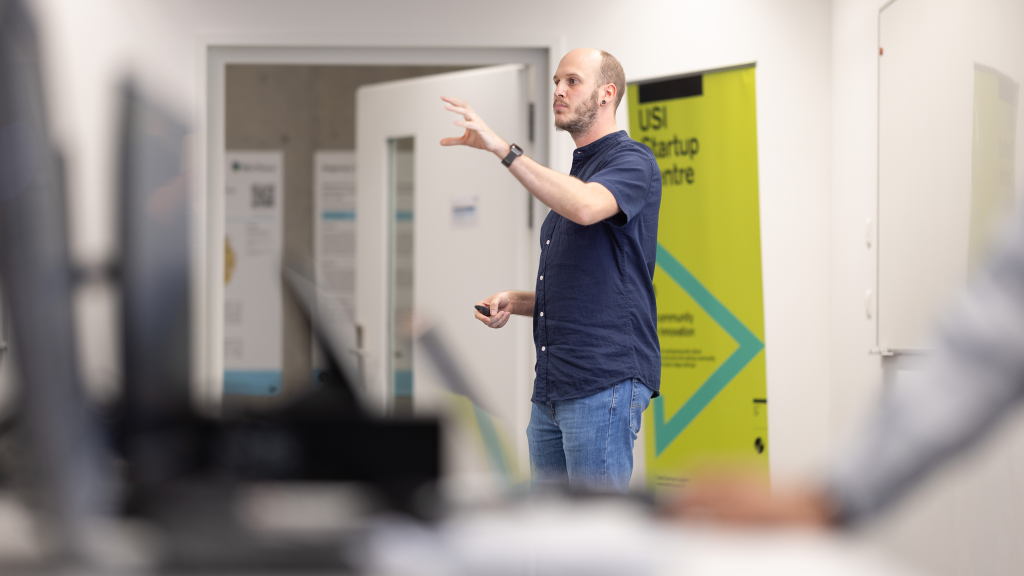
Traditional inspection and monitoring approaches for infrastructures, industrial plants, fleets, and sites rely on large datasets to define all possible issues and malfunctions to be able to detect them. However, these methods are limited and inefficient when it comes to new, unforeseen problems or anomalies in dynamic and evolving systems. Flycatcher is a startup that aims to change these dynamics by providing safe, reliable and cost-effective AI-driven inspection solutions. In this short interview, Dario Mantegazza postdoctoral researcher at IDSIA, co-founder and CEO, talks about their innovative technology and finding the right balance between academia and entrepreneurship.
How did the Flycatcher story begin?
The idea of launching a startup came almost by accident, while bouncing off some ideas with colleagues at the water fountain. Thanks to their suggestions, I participated to some competitions for early-stage startups ideas and participated in the Business Concept course, organised by USI and SUPSI and supported by Innosuisse. At the same time, midway through my PhD, I realized that the technology I was working on could have compelling applications in the real world. That was the moment when I decide to build a company around it.
What does Flycatcher do, and how does it stand out from existing alternatives?
We offer an industrial inspection tool that uses visual data - such as camera and infrared imaging - to detect anomalies in industrial processes. Typically, alternative solutions require clients to provide historical data on recurring issues and then update the system as new issues or problems arise. Our solutions is based on the technology called "Unsupervised Anomaly Detection", which is based on the concept of “normality” and does not require problem data. It was originally applied to cybersecurity and low-dimensional data. During my PhD studies, I experimented with it in the robotics field with promising results. With Flycatcher we aim to empower industries to proactively maintain and monitor their facilities and assets, reducing downtime, and enhancing security, all while optimising operational efficiency.
You are still in the academic world while being an entrepreneur. How do you balance the two?
To be completely upfront, it is a daily struggle to manage both simultaneously, mainly because they require entirely different mindsets. In academia, the focus is on detailed research and the continuous exploration of new topics. On the other hand, in the entrepreneurial world, it’s about engaging with clients, finding tailored solutions, and navigating marketing and management concepts, all things I’m new to. However, what drives me is the opportunity to bridge these two worlds by bringing solutions based on cutting-edge research to the industry.
Who are your role models in the world of entrepreneurship or innovation?
Raffaello D'Andrea, a Canadian-Italian-Swiss engineer, artist, entrepreneur: co-founder of Kiva Systems (now Amazon Robotics) and founder of Verity (innovator in autonomous drones) is 100% among those people. His work bridging academia and industry perfectly reflects my own aspirations. I hope to reach his level one day, or at least have the chance to share a dinner with him.
3 quick questions to wrap it up:
- What is the best advice you’ve received? - Always put your money where your mouth is.
- How do you face obstacles? – Thinking about them at 2 am.
- Where do you see yourself in 10 years? - In a peaceful agritourism in Tuscany, working on agricultural robotics.