Startup story #18 - Vivento Lab
USI Startup Centre
10 March 2025
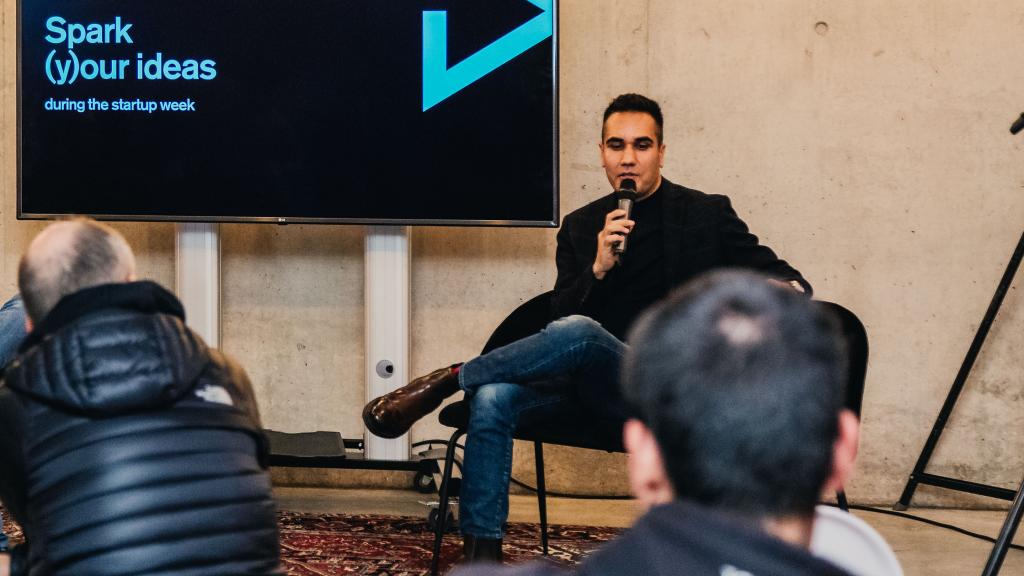
Most existing event management platforms offer rigid, one-size-fits-all solutions, while organisers seek flexibility. This is where Vivento Lab, a company that specialises in event technology solutions and custom software development, comes in. They offer event organisers two tailored solutions: Vivento.Live and Swicket.io. In this short interview, Ed Mehran, CEO and Co-Founder of Vivento Lab, shares insights from his entrepreneurial journey and talks about Vivento’s vision.
This is not your first startup, can you briefly talk about your entrepreneurial journey before Vivento Lab?
My entrepreneurial journey started with my bachelor’s thesis project at USI, which eventually became my first startup in 2013. While it didn’t turn into a full-scale business, it was a valuable learning experience that introduced me to product development, team building, problem-solving, and startup challenges. In 2015, I co-founded my second startup tChat, an app that allowed train passengers traveling on the same route to connect and chat in real time, that gave me firsthand experience in scaling a tech product, managing a team, and securing funding. Later, in 2019, I founded Appybros, a digital and user experience agency specializing in web and mobile application development. As our vision and expertise evolved, we saw a strategic opportunity to align with Vivento Lab. In 2024, Appybros was fully acquired by Vivento Lab, marking a new chapter in our journey. Today, I serve as CEO & Co-Founder, driving innovation in event technology and expanding our impact in the industry.
What motivated you to start your very first project?
During my bachelor’s studies in informatics at USI, I took a course called Business Informatics, where - if I remember correctly - almost every week, our professor invited a new startup founder or business owner to share their journeys, challenges, and insights. Listening to their stories sparked my curiosity and entrepreneurial drive, making me realize that I, too, wanted to build something of my own. Through this course, I discovered Centro Promozione Start-Up (now USI Startup Centre) where I met Umberto Bondi and Roberto Poretti, who provided valuable guidance and encouragement. This experience motivated me to turn my bachelor’s thesis project into a real-world startup, where I could apply my technical and business knowledge.
How do you know if your idea is good enough in the early stages?
The truth is that ideas are cheap - execution and validation are everything. In the early stages, the key question isn’t "Is my idea good?" but rather "Does this idea solve a real, painful problem for a specific group of people?". I use a three-step framework to assess whether an idea has real potential:
- Urgency & market need – Are people actively looking for a solution to this problem, or would you have to convince them they need it? The best ideas solve problems that are painful, frequent, and expensive to ignore.
- Speed of validation – The best way to test an idea is to get real-world signals as fast as possible. Can you get pre-orders, signups, or even verbal commitments before you build anything?
- Product-market fit signals – Once you have an early product, traction isn’t just about downloads or signups - it’s about retention and engagement. Are users coming back? Are they telling others? If people are paying, complaining, or trying to use your product in ways you didn’t anticipate, those are signs you’re onto something valuable.
Coming back to your latest projects, what does Vivento do and what makes it different from competitors?
Most event management platforms on the market offer rigid, one-size-fits-all solutions that force organizers to adapt their workflows to the software. At Vivento Lab, we take the opposite approach - our solutions adapt to the needs of each client, empowering organisers to run events their way. We believe that great events are not just about logistics but about creating meaningful experiences and professional connections. At the moment we offer two products:
Vivento.Live - A comprehensive event management platform for medical, scientific, and professional congresses, as well as cultural festivals. It is fully customizable and unlike standard event platforms, we work closely with organizers to tailor abstract acquisition, speaker management, accreditation tracking, and post-event analytics to their specific processes, ensuring a seamless experience from start to finish.
Swicket.io - A participant management system that simplifies registration, ticketing, check-ins, badge printing, and sponsor lead capture. It is built with data privacy at its core, unlike many event platforms that control and monetize attendee data.
Beyond events, we collaborate with enterprises to build tailored software solutions using a prototyping-first, agile approach. Our focus is on workflow automation, enterprise platforms, and digital transformation, helping businesses optimize operations and drive measurable value.
What have you achieved so far, and what are the next milestones?
Over the past year, we have focused on developing and onboarding key clients in Ticino and beyond, including a major international medical congress in Lugano, which is using Vivento.Live. Swicket.io, our participant management platform, has also been embraced by clients such as USI Study Advisory and Promotion Service to streamline registration, ticketing, and badge check-in.
Looking ahead, our focus in 2025 is on growth - scaling sales and onboarding more major clients for Vivento.Live, positioning it as the go-to platform for medical, scientific events and cultural festivals. Beyond client acquisition, we continue to enhance our ecosystem with AI-driven automation, deeper integrations with major industry tools, CO₂ impact assessment capabilities, and new features designed to make event organization smarter, more efficient, and more sustainable.
What is your approach to hiring? How do you recruit the right talent for your projects?
I strongly believe that building the right team remains one of the most critical factors for success in a startup environment. In a potential candidate, I look for adaptability, curiosity, excitement for our vision and willingness to contribute beyond the specific role. Also, instead of relying solely on interviews, we integrate candidates into short-term, hands-on projects within the team, allowing both sides to assess compatibility in a real-world setting.
3 quick questions to wrap it up:
- What do you like the most about being an entrepreneur? - The ability to create and innovate. I love turning ideas into real solutions that solve problems and add value.
- How do you stay motivated when things do not go as planned? - Challenges are part of the journey. When things don’t go as planned, I remind myself why I started and focus on learning from failures rather than fearing them.
- What is the most important lesson you’ve learned from your startup experience? - Execution is everything. A great idea is worthless without strong execution, persistence, and adaptability. But just as important is the willingness to keep learning.