
Startup story #22 - BigOmics Analytics
USI Startup Centre
1 April 2025
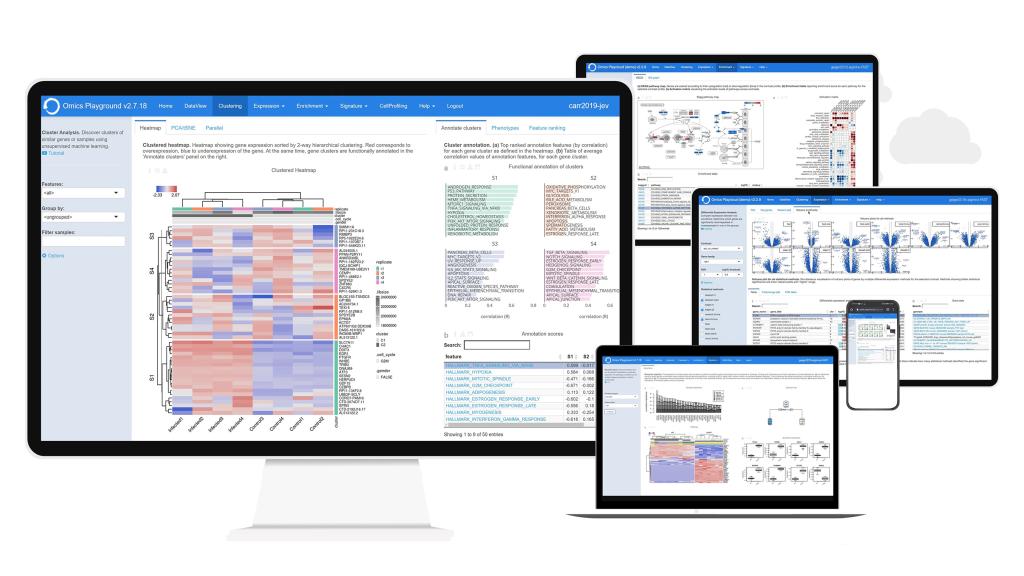
BigOmics Analytics empowers biologists to perform complex omics data analysis in a few clicks, thanks to their easy-to-use and interactive platforms, reducing discovery time and R&D overhead costs in data-driven therapeutics and precision medicine. In this brief interview, Murat Akhmedov and Ivo Kwee share the story behind this project.
The BigOmics Analytics journey started back in 2017. How has the project evolved since then?
In the early days, from 2017 to 2021, we both worked part-time at IOR and then IRB, supporting biologists and developing our platform. At that time, everything was completely bootstrapped. We later secured seed funding from Ti-Ventures and became full-time founders in 2021. As we both came from academic backgrounds, it was initially easier for us to convince clients from academia. We then began approaching small biotech companies and gradually shifted focus to larger ones. Since last year, we’ve been concentrating on top pharmaceutical companies, which is incredibly exciting. We are getting closer to product-market fit. The challenges around product development have shifted slightly compared to the beginning. Now, we receive more feedback from clients, which enables us to improve. However, we must be careful not to stray from our vision and keep the complexity in check.
Who are your customers?
Our platform primarily targets the pre-clinical stage, as the development of any new therapy begins with understanding the disease through large volumes of molecular-level data. Depending on the size and structure of the company, our primary contacts are typically the Head of Data Science or Head of Biology. Sometimes, the sales process works bottom-up, where we target biologists, computational biologists and bioinformaticians.
We use multiple channels to reach our target customers, including conferences where we can meet people face-to-face and initiate conversations, inbound marketing with lots of educational content around data analysis and free trials to test our platform. In our case, it is also important to distinguish between users and buyers. When selling to large organisations, the sales cycle is much longer, and it is important to understand the internal dynamics and how different stakeholders involved in the decision-making process interact among them.
How are you managing this growing complexity and structuring your sales process?
We are now in a much better position than we were 2-3 years ago. Gabriela Scorici, our Marketing Manager, is doing an excellent job with marketing automation. On the sales side, we recently welcomed Jonathan Manson-Hennig to the team.
Once we identify an internal champion — someone who is enthusiastic about using our platform — we create an account map that outlines users, decision makers, potential gatekeepers, and so on. If there is interest after the first demo and the potential client could benefit from our solution, we gradually involve various team members in the discussion to address different questions. When it comes to the purchasing decision, we build a business case that calculates Return on Investment (ROI) using both quantitative and qualitative metrics. For example, thanks to the Omics Platform, we can increase the speed of analysis by a factor of ten compared to the standard.
What are your next milestones and your long-term vision?
Our next objective is to secure our first deals with big pharma, demonstrating that our solution works not only for academic labs or small and medium-sized biotech companies. In the future, once we have top pharmaceutical companies as clients, we will need to show how we can expand and grow our collaborations with these clients. In this regard, we can leverage the fact that we offer a centralised tool, bringing together all experimental data—often expensive to generate—in one place, with a standardised approach.
Our vision is to become the industry standard in omics data analysis, a platform that people know and trust. The main product of biotech and pharma companies are drugs or other therapies. Therefore, it is important for us to become a central part of the drug development process in the framework of data-driven precision medicine. We are now looking to raise our Series A round to expand the team and accelerate growth.
What has been your experience of building a team from the early days to today?
Many founders struggle to find a co-founder in the early stages. We had the advantage of already knowing each other and having worked together for four years before starting BigOmics. Initially, we handled everything ourselves, and while delegating was not always easy, we learned to recognise when other team members were better suited to certain tasks, and we definitely will have to learn more as the team grows. In the early days, we had several team members working remotely from different locations, but this didn’t work well as they didn’t feel truly involved. Over time, we found people already based in or willing to relocate to Ticino, and now we are a team of seven that can gather in one office, which makes it much easier to iterate fast, exchange perspectives, and learn from each other.
3 quick questions to wrap it up:
- What would you do differently next time? We are doing our best to do things the right way, but you learn as you go, and there is always room for improvement. For example, setting up structure and documenting processes from the very beginning is invaluable, even if it seems like a waste of time initially.
- What keeps you motivated? The fact that our vision from seven years ago is becoming a reality and positive feedback from our clients.
- What is your secret of a strong co-founding team? Respect and the ability to have a healthy argument.