
Startup story #25 - QM Project
USI Startup Centre
5 May 2025
From predicting hypoxia in pilots to optimising performance in clinical trials, QM Project is building an innovative AI technology that brings the “Human Factor”, the psychophysical response of individuals to real-world stimuli, into engineered systems. The startup is developing a proprietary platform that uses bio signals and environmental data to understand and predict how humans react in critical situations in real time, proposing appropriate actions. In this brief interview, Matteo Bigogno, founder and CEO, shares insights about the project.
What does QM Project do?
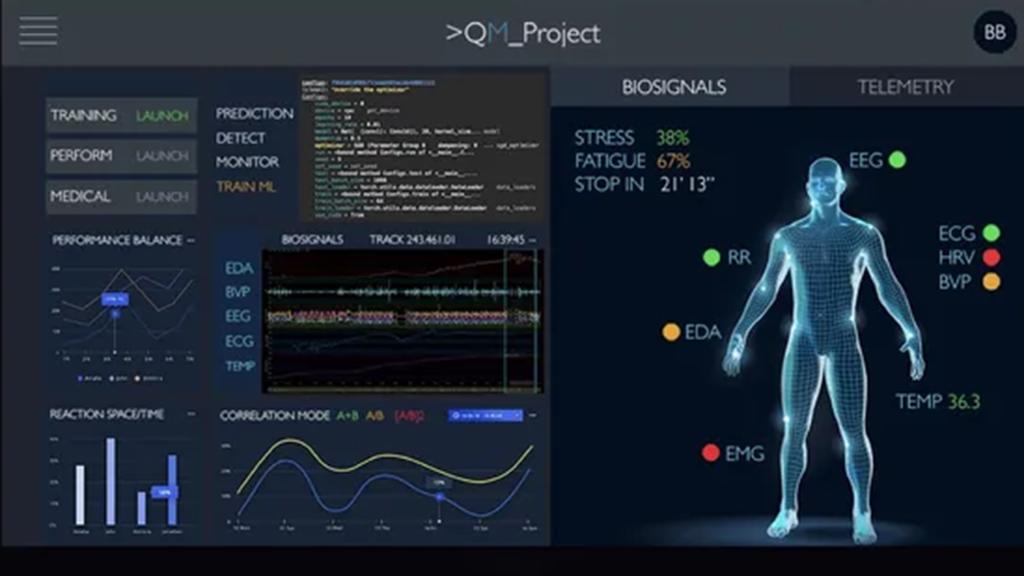
Human reaction (“The Human Factor”) to a critical situation may significantly influence the outcome, potentially leading to undesired consequences. We build models based on Artificial Intelligence and Machine Learning that can understand and predict the correlation between environmental factors and human responses in extreme situations. To do this, we are creating a platform that combines inputs from a wide range of different sensors and wearable devices to provide a real-time, contextual understanding of human performance. With this approach, we can provide solutions for different applications, from training and performance optimisation to safety and medical R&D, essentially, anywhere human decisions might impact outcomes in critical environments.
How does your platform work?
The platform collects and processes bio signals and contextual telemetry, which refers to the remote collection and transmission of environmental and situational data from sensors and devices. Using machine learning, it can identify patterns and predict risks such as hypoxia, stress overload, or critical treatment reactions, supporting human decision-making for both real-time intervention and retrospective analysis. The platform also enables cross-domain learning, making the technology highly scalable. For example, we can apply insights from the aviation sector to sleep apnea or obesity-related risks.
Do you also provide interpretation or just data?
We provide the tools and analysis, but the interpretation remains with domain experts. For example, our platform might detect signs of hypoxia, but it’s the flight physician who determines the appropriate action.
What have you achieved so far and what are your next milestones?
We are currently integrating multiple sensors into our platform and have already tested it with our research partner in the Netherlands, capturing and interpreting human reactions in several complex conditions. These findings will soon be published in several academic articles. Our next goal is to complete the platform and onboard new clients across Europe, while also establishing further research collaborations.
3 quick questions to wrap it up:
- What keeps you going? I really believed in the project from the beginning, and I want to bring this vision to life
- What is the hardest part of being an entrepreneur? Doing everything at once, from being the CEO to handling travel logistics.
- What is the most important thing to never forget when working on a startup? Constantly having a reality check, testing and re-testing your assumptions.