

Startups meet established companies
USI Startup Centre
2 October 2026
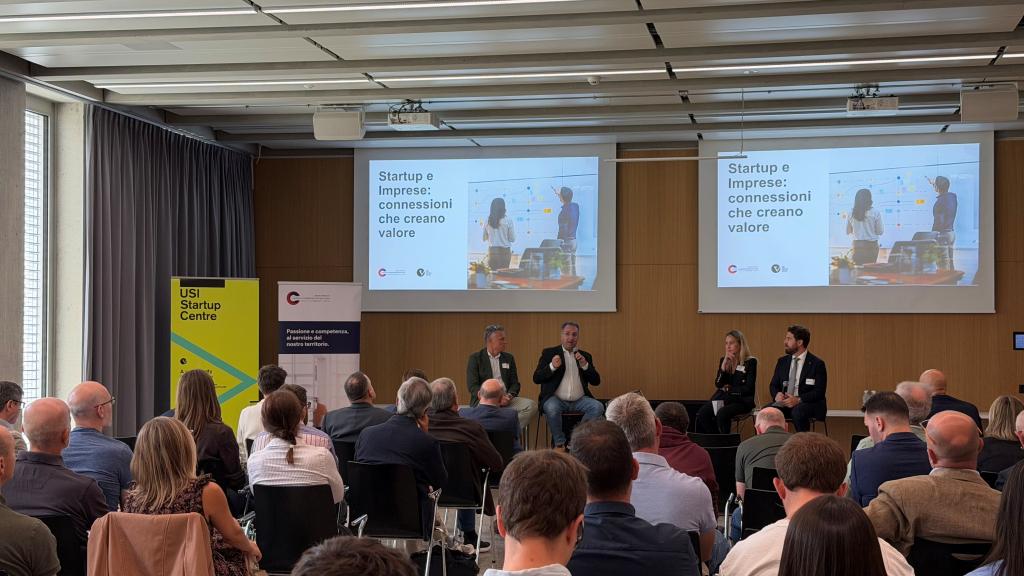
On 23 September, the Ticino Chamber of Commerce (Cc-Ti) and USI Startup Centre brought together companies and startups to explore how collaboration can create value for both sides.
The event gathered around 70 participants, including startup founders, company representatives and ecosystem players, with the aim of raising awareness of what collaborations between established companies and startups can look like and starting new conversations across the local ecosystem. The programme opened with two testimonials, BancaStato with DEC Energy and Ente Ospedaliero Cantonale with Hoxell, in which company and startup told the story of their collaboration from their own point of view, offering the audience a first-hand look at the journey that brought each partnership to life.
A roundtable followed with Michele Merazzi (Chief Operations Officer, Cc-Ti), Francesco Lurati (Director, USI Startup Centre) and Daniele Farrace (Chief Innovation Officer, AEM), moderated by Paolo Rossi, former director of AET and AEM. The discussion built on the testimonials and kept returning to the idea that a conversation is only a starting point: for it to lead somewhere, a company needs to be permeable to ideas and solutions coming from outside, and it needs to know which problem it wants to solve and what it is ready to invest, also thinking beyond the first pilot.
Turning a promising start into a lasting collaboration also depends on mutual trust, which proximity helps to build, and on an alignment between startups and established companies that accounts for their different speeds and structures. Today it is often startups that are invited to approach companies, either directly or through dedicated programmes, but the ecosystem gains even more when the movement goes in both directions. Companies can play a more active role by openly sharing their needs and the kind of partners they are looking for, and by looking beyond their own sector, which may bring to light latent needs that have not yet been noticed or defined. Companies that take this step and are clear about what they can contribute make it easier for startups to find the right counterpart and for a first conversation to become something concrete.